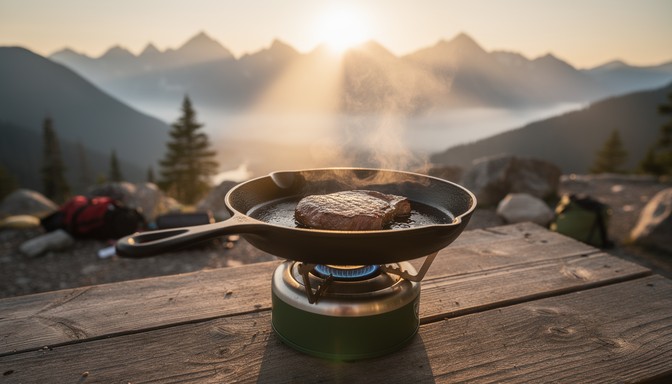
A hot meal at the end of a long day in the backcountry is not a luxury — it is a morale essential. Whether you are boiling water for a freeze-dried dinner at 11,000 feet or cooking a real breakfast at a base camp, the right stove makes it fast, reliable, and simple.
The market splits into a few clear categories: ultralight canister stoves for fast and simple cooking, alcohol stoves for minimalist gram-counters, and liquid fuel stoves for cold weather and extended expeditions. Here is what is worth carrying.
Quick Answer
- Best overall: MSR PocketRocket 2 — ultralight, fast, reliable, works in most conditions (~$45)
- Best for fast boiling: Jetboil Flash — integrated system, boils water in 100 seconds, extremely efficient (~$110)
- Best for real cooking: MSR WindBurner Duo — stable, wind-resistant, fits a proper cook pot (~$230)
- Best budget pick: Gas One Backpacking Stove — simple, lightweight, affordable (~$10)
- Best for cold weather and expeditions: MSR WhisperLite Universal — liquid fuel, works in extreme cold, field repairable (~$200)
- Best ultralight option: Soto Windmaster — 67g, exceptional wind resistance for its size (~$70)
Our Picks
1. MSR PocketRocket 2 — Best Overall
Price: ~$45 | Weight: 2.6 oz | Boil time: 3.5 min per liter | Fuel: Isobutane canister
The PocketRocket 2 is the stove most backcountry hikers should buy. It weighs less than three ounces, screws onto any standard isobutane canister, and boils water reliably in most three-season conditions. The fold-out pot supports are stable enough for a standard cook pot, and the simmer control is better than most stoves in this price range.
It is not perfect in wind — no canister stove is — but for protected cooking spots and three-season Rocky Mountain use it handles everything you will throw at it.
Pros:
- Ultralight at 2.6 oz
- Affordable for the quality and reliability
- Screws onto any standard isobutane canister
- Good simmer control for a stove at this price
- Compact — fits inside a standard cook pot for packing
Cons:
- Wind performance is average — needs a windscreen or sheltered spot
- Not ideal below freezing — canister pressure drops in cold temperatures
- No integrated pot — you need to bring your own cookware
- Pot supports are small — unstable with larger pots
2. Jetboil Flash — Best for Fast Boiling
Price: ~$120 | Weight: 13.1 oz with cup | Boil time: 100 seconds per liter | Fuel: Isobutane canister
If your backcountry cooking consists mostly of boiling water for coffee, oatmeal, and freeze-dried meals, the Jetboil Flash is hard to beat. The integrated burner and insulated cup system is extraordinarily efficient — a liter of water boils in 100 seconds using less fuel than almost any other stove. The push-button igniter, color-changing heat indicator, and self-contained system make it the fastest and most convenient option available.
The trade-off is that the integrated system is designed for boiling, not real cooking. Simmering and frying are possible but awkward.
Pros:
- 100-second boil time is the fastest in this guide
- Extremely fuel-efficient — makes canisters last significantly longer
- Integrated insulated cup keeps food warm while eating
- Push-button igniter — no lighter needed
- Everything nests together into a compact, self-contained unit
Cons:
- Heavier than a simple canister stove at 13.1 oz with cup
- Designed for boiling — poor simmering control for real cooking
- Proprietary cup system — less versatile than a standard stove
- More expensive than comparable boiling-only options
3. MSR WindBurner Duo — Best for Real Cooking
Price: ~$230 | Weight: 15.8 oz with pot | Boil time: 4.5 min per liter | Fuel: Isobutane canister
The WindBurner Duo is built around a radiant burner design that performs exceptionally well in wind — the main weakness of standard canister stoves. The 1.8-liter pot fits two people comfortably for real meals rather than just rehydrated food, and the stable base handles a loaded pot without the wobble that plagues smaller stoves. For two-person trips where you want to cook actual food rather than just add boiling water to a bag, it is the best integrated system available.
Pros:
- Radiant burner design resists wind far better than standard canister stoves
- 1.8-liter pot comfortably feeds two people
- Stable base handles heavy pots securely
- Good simmer control for a canister stove
- Everything nests together neatly
Cons:
- Heaviest option in this guide at 15.8 oz
- Most expensive canister stove here
- Boil time is slower than the Jetboil Flash
- Proprietary pot system limits cookware flexibility
4. Gas One Backpacking Stove — Best Budget Pick
Price: ~$15 | Weight: 3 oz | Boil time: ~4 min per liter | Fuel: Isobutane canister
If you want a functional canister stove without spending serious money, the Gas One delivers. It is light, simple, and works reliably in three-season conditions. Build quality reflects the price — it is not as refined as MSR or Jetboil — but for occasional use or as a backup stove it does everything a backcountry stove needs to do.
Pros:
- Extremely affordable
- Lightweight at 3 oz
- Works with standard isobutane canisters
- Simple and reliable for three-season use
Cons:
- Build quality is noticeably below premium options
- Poor wind performance
- Less precise simmer control
- Not suitable for serious cold-weather use
5. MSR WhisperLite Universal — Best for Cold Weather and Expeditions
Price: ~$200 | Weight: 11.2 oz | Boil time: 3.5 min per liter | Fuel: Liquid fuel or isobutane canister
Canister stoves lose pressure and performance in cold temperatures — below about 20°F they become unreliable. Liquid fuel stoves like the WhisperLite Universal do not have this problem. They burn white gas, kerosene, and unleaded gasoline — fuels that perform consistently in extreme cold and are available worldwide. The WhisperLite can also be field-repaired with a basic tool kit, which matters on extended expeditions far from a gear shop.
For three-season Rocky Mountain hiking, a canister stove is simpler and sufficient. For winter camping, high-altitude mountaineering, or international travel, the WhisperLite is the right tool.
Pros:
- Performs reliably in extreme cold where canister stoves fail
- Burns multiple fuel types including white gas and unleaded gasoline
- Field repairable with included maintenance kit
- Proven reliability over decades of expedition use
- Works at altitude where canister pressure drops
Cons:
- Heavier and more complex than canister stoves
- Requires priming before use — slower to get going than canister stoves
- Liquid fuel requires a separate fuel bottle
- Overkill for three-season hiking at moderate elevations
6. Soto Windmaster — Best Ultralight
Price: ~$60 | Weight: 2.3 oz | Boil time: 2.5 min per liter | Fuel: Isobutane canister
The Windmaster is the best ultralight canister stove available for Rocky Mountain conditions. At 2.3 oz it is lighter than the PocketRocket 2, and its micro-regulator technology maintains consistent output as the canister empties and temperatures drop — a significant practical advantage over standard canister stoves. Wind performance is genuinely impressive for a stove this size.
For gram-conscious backpackers who do not want to sacrifice reliability for weight, it is the best single-burner canister stove available.
Pros:
- Lightest stove in this guide at 2.3 oz
- Micro-regulator maintains consistent output in cold and as canister empties
- Excellent wind resistance for its size
- Fast boil time of 2.5 minutes per liter
- Compact and packable
Cons:
- More expensive than the PocketRocket 2 for similar functionality
- Four-flex pot support sold separately — standard pot support is small
- Less widely available than MSR and Jetboil options
What to Look for When Choosing a Camp Stove
Fuel Type
Isobutane canisters — the standard for most backcountry use. Clean burning, easy to use, widely available at outdoor retailers. Performance drops in cold temperatures and as the canister empties. Not available everywhere internationally.
Liquid fuel (white gas) — performs in extreme cold and at altitude, available worldwide, more economical on long trips. Requires more setup and maintenance than canister stoves.
Alcohol — ultralight and simple, virtually no moving parts to fail. Slow boil times, poor performance in wind and cold, and no flame control. Best for ultralight minimalists on warm-weather trips.
Solid fuel tablets — emergency use only. Slow, smelly, and leaves residue. Worth carrying as a backup but not a primary cooking method.
Weight
For backpacking, stove weight matters. A simple canister stove like the PocketRocket 2 or Soto Windmaster weighs under 3 oz. An integrated system like the Jetboil adds the weight of the cup but saves overall system weight through fuel efficiency. Factor in the weight of your cook pot, fuel canister, and lighter when comparing systems.
Wind Performance
Wind is the biggest variable in backcountry cooking performance. Standard canister stoves lose significant output in even moderate wind. Solutions include:
- Choosing a stove with better wind resistance (Soto Windmaster, MSR WindBurner)
- Using a windscreen — a simple foil windscreen costs nothing and makes a significant difference
- Positioning your stove in a sheltered spot — behind a rock, a pack, or a natural wind break
Never use a windscreen with an integrated canister stove like the Jetboil — heat buildup around the canister is a safety risk.
Boil Time and Fuel Efficiency
Boil time matters most when you are cold, hungry, and tired. The Jetboil Flash wins on raw speed. For fuel efficiency over a long trip, integrated systems like the Jetboil and WindBurner use significantly less fuel per boil than open burner stoves — which means carrying fewer or smaller canisters.
Cooking vs. Boiling
If your backcountry meals are freeze-dried or instant — just add boiling water — any stove works. If you want to actually cook — simmer sauces, fry eggs, make real meals — you need a stove with good simmer control and a stable platform for a proper pot. The WindBurner Duo and WhisperLite are the best options here.
Stoves by Use Case
Solo Backpacker — Freeze-Dried Meals and Coffee
Fast, light, and simple. Boiling water is all you need.
- Best choice: Jetboil Flash
- Ultralight option: Soto Windmaster
- Budget option: MSR PocketRocket 2
Two-Person Trip — Real Cooking
Stability, wind resistance, and a proper pot size matter more than weight.
- Best choice: MSR WindBurner Duo
Winter Camping or High-Altitude Mountaineering
Canister stoves lose reliability below 20°F. Liquid fuel is the right call.
- Best choice: MSR WhisperLite Universal
Car Camping or Base Camp
Weight is not a concern. A larger two-burner propane stove gives you a full cooking experience.
[Recommended: Camp Chef Two-Burner Propane Stove]
Don’t Forget
A lighter or matches — even stoves with built-in igniters can fail. Always carry a backup lighter.
MK Candle Lighter – refillable butane
A pot — most stoves do not include cookware. A 0.9-liter titanium pot handles solo cooking; a 1.5 to 2-liter pot suits two people.
Fuel — isobutane canisters are available at REI, outdoor retailers, and many sporting goods stores. Do not count on finding them at a gas station. Buy before you go.
A windscreen — a simple folded foil windscreen weighs almost nothing and significantly improves performance in wind for open burner stoves.
[Recommended: MSR Heat Reflector]
Frequently Asked Questions
How much fuel do I need?
A rough guide for isobutane canisters: a 100g canister provides roughly 45 minutes of burn time for a standard canister stove — enough for 8 to 10 boils. For a solo weekend trip of two to three days, one 100g canister is usually sufficient. For a week-long trip or two people, carry two. Integrated systems like the Jetboil use significantly less fuel per boil — one 100g canister can last a solo hiker up to five days.
Can I use any canister with my stove?
Most canister stoves use a standard Lindal valve fitting and are compatible with canisters from MSR, Jetboil, Snow Peak, Primus, and other major brands. Always verify compatibility before your trip — a mismatched canister and stove is a frustrating problem to have at the trailhead.
Are canister stoves allowed in fire-restricted areas?
In most cases yes — canister stoves are generally permitted even when campfires are prohibited. Always check current regulations for your specific area before your trip as rules vary by land management agency and fire conditions.
How do I dispose of empty fuel canisters?
Puncture empty canisters before recycling — most outdoor retailers sell inexpensive canister puncture tools for this purpose. An unpunctured canister cannot be recycled and should not go in regular trash. Some outdoor retailers accept empty canisters for proper disposal.
How do I cook at altitude?
Water boils at a lower temperature at altitude — around 194°F at 10,000 feet compared to 212°F at sea level. This means longer cooking times for anything that requires boiling. Freeze-dried meals and instant foods are largely unaffected. For real cooking, add time rather than increasing heat — the temperature ceiling is lower regardless of how high your flame is.
Prices are approximate at time of writing. As an Amazon Associate, we earn from qualifying purchases.